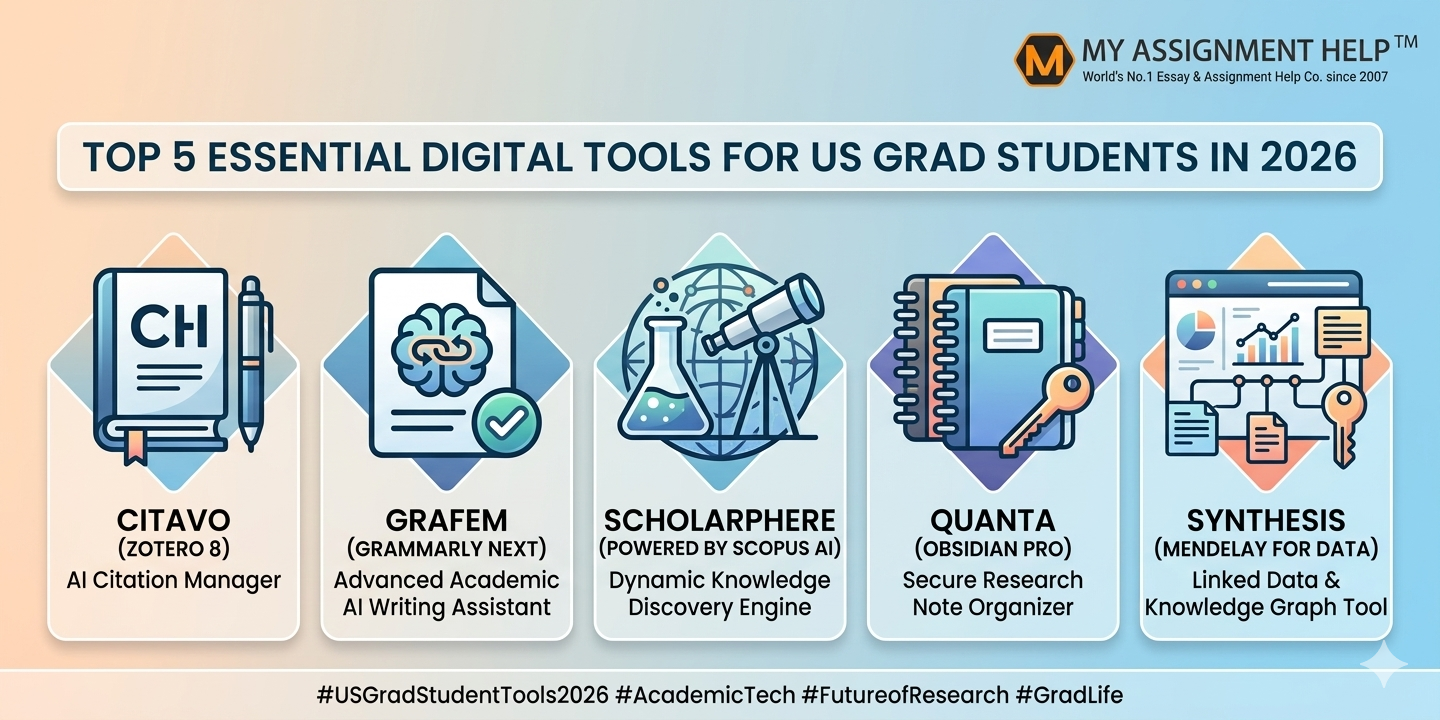
The 2026 academic landscape has moved far beyond simple word processors and basic search engines. For postgraduates in the United States, the pressure to produce high-impact research while managing increasingly complex datasets has reached a fever pitch. With the integration of advanced neural networks into mainstream academia, the “digital toolkit” is no longer an optional luxury—it is the backbone of scholastic survival.
Success in a Master’s or PhD program now requires a blend of computational efficiency and cognitive offloading. Whether you are navigating the intricate proofs of a STEM thesis or the qualitative nuances of a sociological dissertation, the right software can be the difference between burnout and a breakthrough.
As academic rigor intensifies, many students find that even the best tools cannot replace human expertise in highly technical domains. For instance, those grappling with complex variables or advanced statistical modeling often seek specialized Mathematics assignment help to ensure their quantitative analysis meets the stringent peer-review standards of 2026. This balance of digital automation and expert intervention defines the modern high-achieving student.
1. ResearchRabbit: The AI-Powered Literature Discovery Matrix
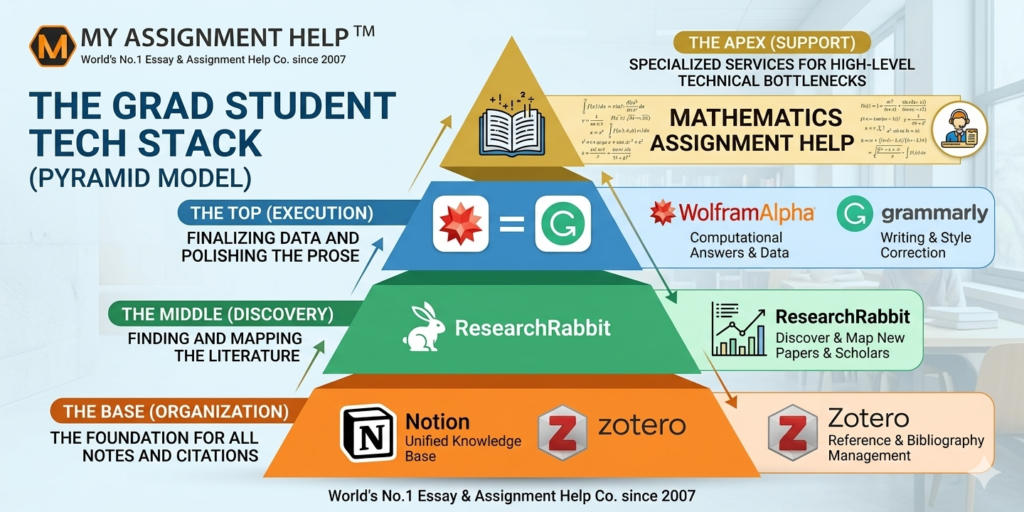
In 2026, the sheer volume of published papers is staggering. ResearchRabbit has evolved into a “Spotify for Papers,” using collaborative filtering to map the relationship between citations.
- Why it’s essential: It visualizes your research field as a dynamic map. By adding a few “seed papers,” the tool automatically finds related works, identifies key authors, and alerts you to new publications in real-time.
- The 2026 Edge: Enhanced integration with institutional libraries allows for one-click access to paywalled content (legally via university credentials).
2. Notion AI: The Central Nervous System for Dissertations
Notion has transitioned from a simple note-taking app to an all-in-one workspace that manages information architecture. For US grad students, it serves as a central repository for meeting notes, project timelines, and draft chapters.
- Why it’s essential: Its ability to handle LaTeX for formulas and toggle lists for massive bibliographies makes it indispensable.
- The 2026 Edge: Its integrated AI assistant now specializes in “summarization and synthesis,” helping students condense 50-page PDFs into 500-word executive summaries.
3. Zotero 7.0: The Gold Standard in Citation Management
While several competitors exist, Zotero remains the favorite for its open-source transparency and robust browser integration. In 2026, its ability to automatically extract metadata from obscure digital archives is unmatched.
- Why it’s essential: It eliminates the manual labor of formatting bibliographies in APA 7th, MLA 9th, or Chicago styles.
- The 2026 Edge: New collaborative folders allow research teams to share sources instantly with cloud-synced annotations.
4. WolframAlpha Pro: The Computational Intelligence Engine
For students in data science, economics, or engineering, WolframAlpha is the ultimate “answer engine.” Unlike LLMs, which may hallucinate facts, WolframAlpha uses a curated knowledge base and symbolic language to provide accurate computational results.
- Why it’s essential: It solves complex differential equations and provides data visualization that is ready for publication.
- The 2026 Edge: Enhanced data upload features allow students to feed in raw CSV files for instant trend analysis and anomaly detection.
5. Grammarly Author: Beyond Basic Spellcheck
In 2026, Grammarly has moved into “Ethical AI Writing Support.” It doesn’t just fix commas; it analyzes the “tone of authority” required for academic journals. It ensures that the writer’s voice remains central while polishing the structural integrity of the prose.
The Human Element in a Digital World
While these tools streamline the technical aspects of research, the demand for high-quality, original academic writing remains paramount. Navigating the “publish or perish” culture of US universities often requires a collaborative approach. Many students supplement their digital toolkit with professional assignment writing help to refine their arguments and ensure their work adhereNavigating the Digital Frontier: Top 5 Essential Digital Tools for US Grad Students in 2026s to the highest standards of E-E-A-T (Experience, Expertise, Authoritativeness, and Trustworthiness).
Key Takeaways
- Efficiency is King: Tools like ResearchRabbit save hundreds of hours in literature reviews.
- Data Integrity: WolframAlpha Pro is the reliable choice for quantitative accuracy over generative AI.
- Structure Matters: Notion AI helps maintain a coherent information architecture for long-form dissertations.
- Hybrid Success: The most successful students combine top-tier digital tools with expert human consultancy.
FAQ Section
Q: Are these tools considered “cheating” by US Universities?
A: No. These are productivity and research tools. However, always check your specific university’s “Academic Integrity” policy regarding the use of generative AI for drafting content.
Q: Which tool is best for qualitative research?
A: Notion and NVivo are the industry leaders for organizing qualitative interviews and thematic coding.
Q: How much should a grad student budget for these tools?
A: Most offer a “Freemium” model. Expect to spend approximately $15–$30 AUD (equivalent) per month for “Pro” features across two or three essential services.
Author Bio
Dr. Aris Thorne is a Senior Academic Consultant at MyAssignmentHelp. With over a decade of experience in content strategy and higher education, Dr. Thorne specializes in helping postgraduate students navigate the complexities of digital research and academic ethics. Having worked across the US and Australia, they bring a global perspective to EdTech and student productivity.
Data Sources and References
- National Center for Education Statistics (2025) – Trends in Graduate Enrollment and Digital Literacy.
- Journal of Academic Research Support (2026) – The Impact of AI-Driven Discovery Tools on Literature Review Speed.
- Global EdTech Review – Comparing Computational Engines: WolframAlpha vs. LLMs in STEM.