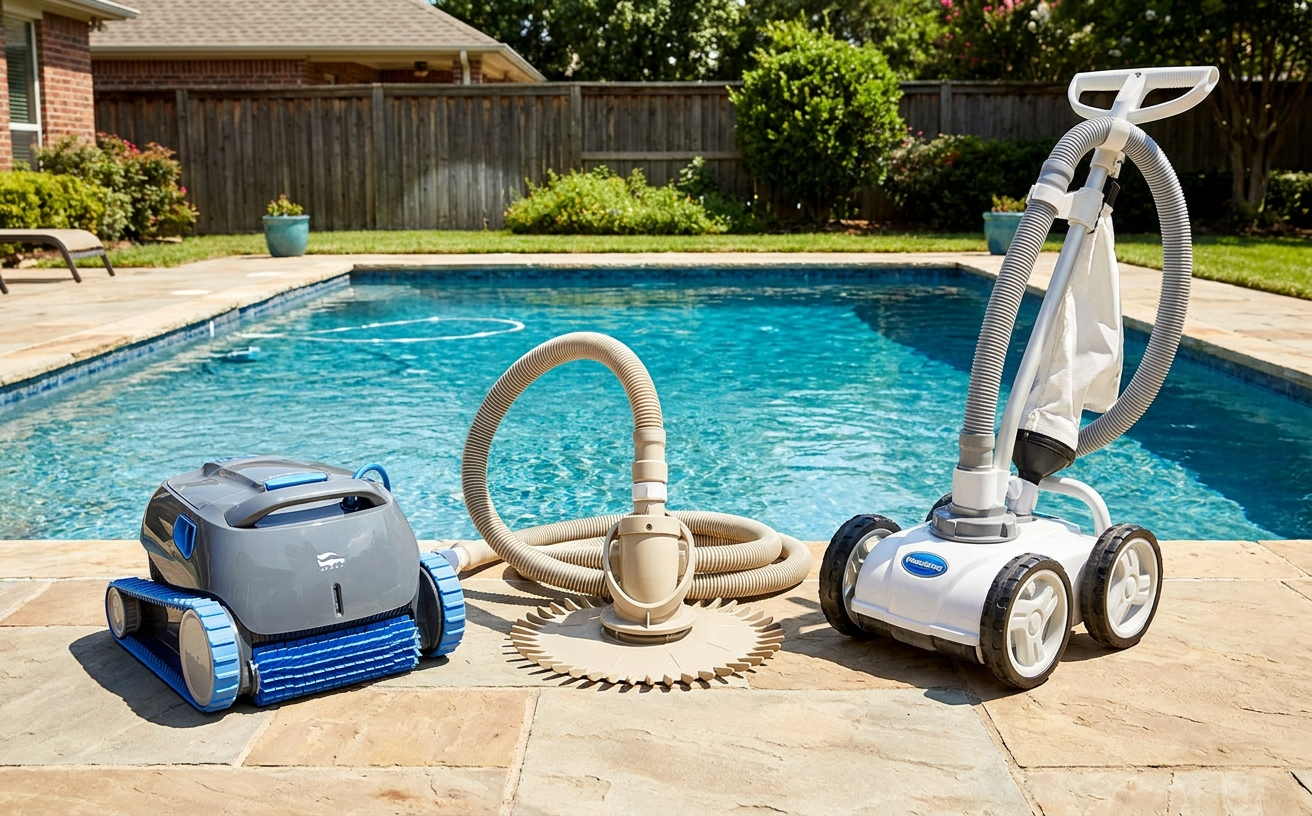
Every automatic pool cleaner does the same basic job: it removes debris from your pool so you do not have to do it by hand. But the way each type accomplishes that job is so fundamentally different that comparing them by price alone misses the point entirely.
Suction-side cleaners, pressure-side cleaners, and robotic cleaners each operate on a distinct mechanical principle. Each has strengths the others cannot match, and weaknesses the others do not share. Understanding these differences is the only reliable way to choose the right one for your pool.
Suction-Side Cleaners: The Simple Attachments
How They Work
A suction-side cleaner connects to your pool’s skimmer or a dedicated suction port. It uses the suction generated by your main pool pump to create movement and pull debris through the cleaner’s body and into your filter system. There is no separate motor, no separate power source, and no separate filtration.
The cleaner moves randomly across the pool floor, driven by water flow through an internal mechanism that pulses or oscillates to create directional changes. Some models use a hammer mechanism that taps the unit forward. Others use a diaphragm that contracts and expands with water pressure.
Strengths
- Lowest purchase price among all automatic cleaners
- No additional electricity cost since it runs on the pump you already have
- Very few moving parts, which means fewer things that can break
- Debris goes directly to your existing filter, no separate cleaning step
Weaknesses
- Adds load to your pump and filter, reducing their effective capacity for circulation
- Cannot climb walls effectively in most configurations
- Struggles with large debris like wet leaves, which clog the intake
- Random coverage pattern leaves dead spots that get cleaned only by chance
Pressure-Side Cleaners: The Powered Sweepers
How They Work
A pressure-side cleaner uses water pressure, not suction, to move and collect debris. It connects to a dedicated return line or a booster pump that pushes pressurized water through a hose to the cleaner. The water pressure drives the wheels and creates a venturi effect that pulls debris into an onboard filter bag.
Because debris is collected in the cleaner’s own bag rather than sent to the main filter, pressure-side cleaners reduce the load on your pool’s filtration system. They also tend to pick up larger debris than suction-side models because the venturi intake handles bulky items that would clog a suction hose.
Strengths
- Does not add load to your main filter since debris stays in the cleaner’s bag
- Handles large debris including wet leaves and twigs
- More deliberate movement pattern than suction-side cleaners
- Can distribute clean water across the pool as it moves
Weaknesses
- Requires a dedicated return line or booster pump, which adds installation cost
- Booster pump adds to your electricity bill when running
- Does not climb walls in most models
- Onboard bag needs manual emptying after each cycle
Robotic Cleaners: The Independent Units
How They Work
A robotic cleaner is entirely self-contained. It has its own electric motor, its own pump, its own filtration system, and its own power supply. You plug it into a standard outlet, drop it in the pool, and it operates independently of your pool’s circulation system.
Inside the cleaner, a drive motor moves the unit across the floor and up the walls. A separate pump motor draws water through a filter cartridge or bag, capturing debris and returning filtered water to the pool. More advanced models use gyroscopes or scanning sensors to map the pool and follow an efficient cleaning path.
For anyone trying to decide between these fundamentally different approaches, a pool cleaner types comparison that breaks down real-world performance rather than just specifications is essential reading.
Strengths
- Completely independent of your pool pump and filter system
- Climbs walls and cleans the waterline in addition to the floor
- Fine filtration captures particles too small for other cleaner types
- Smart navigation covers the entire pool methodically rather than randomly
Weaknesses
- Highest purchase price of the three types
- Requires removal from the pool and filter cleaning after each use
- Power cable can tangle or catch on pool features
- Heavier and more awkward to handle than hose-based cleaners
Where Each Type Performs Best
Suction-side cleaners make sense for small to medium pools with light to moderate debris, where the owner already runs the pump for eight or more hours per day. The cleaner adds no energy cost because the pump is running anyway, and the random coverage pattern is adequate for pools without significant dead zones.
Pressure-side cleaners excel in larger pools with heavy leaf fall. The onboard bag captures bulky debris before it reaches the main filter, reducing backwash frequency and extending filter life. The booster pump adds some electricity cost, but the savings in filter maintenance often offset it.
Robotic cleaners are the right choice when wall cleaning matters, when fine filtration is needed for cloudy water, or when the owner wants to run the cleaner independently of the pump schedule. They also work well in pools with complex shapes where random coverage patterns leave significant areas untouched.
The Decision Framework
Choose based on your pool’s specific needs, not on which type is supposedly better overall. No type is universally superior. Each one solves a different problem more effectively than the others.
If your primary issue is light floor debris and you already run your pump long hours, suction-side is the economical choice. If you battle heavy leaf fall and want to protect your filter, pressure-side is the practical answer. If you need wall cleaning, fine filtration, or independent operation, robotic is the only type that delivers.
The wrong choice is not the cheapest one. The wrong choice is the one that does not solve your specific problem. A suction cleaner in a leaf-heavy pool will clog constantly. A robotic cleaner in a small pool with light debris will never justify its cost. Match the tool to the task, and any of the three will serve you well.